

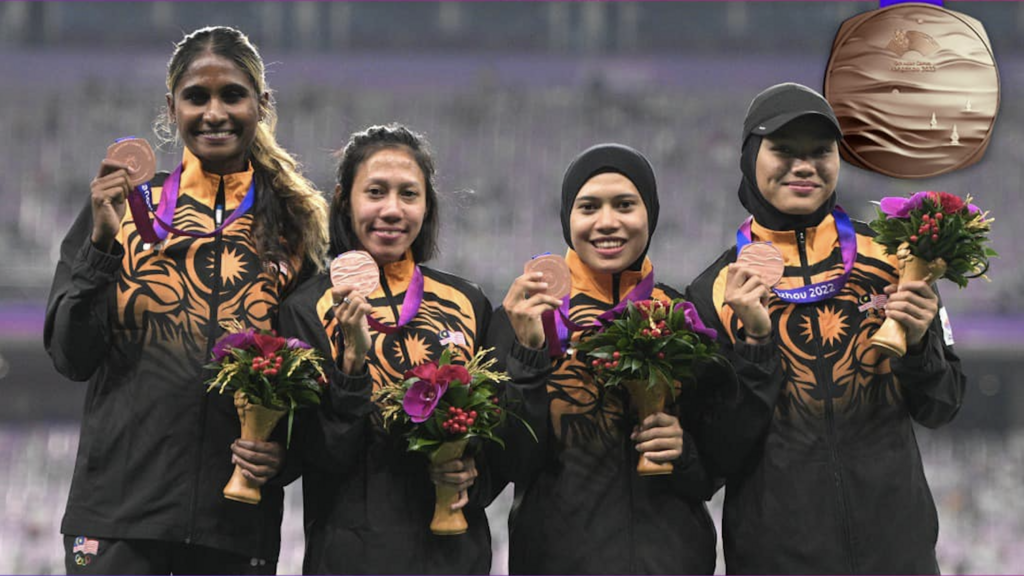

KUALA LUMPUR – The national women’s 4x100m relay team set a new national record at the Hangzhou Asian Games, en route to winning a bronze medal at the Olympic Sports Centre Stadium today.
The Malaysian team of Shereen Samson Vallabuoy, Azreen Nabila Alias, Nur Afrina Batrisyia, and Zaidatul Husniah Zulkilfli, clocked 45.01 seconds, erasing the previous record of 45.18 seconds set by Zaidatul, Siti Fatimah Mohamad, S. Komalam, and Nurul Faizah Asma Mazlan, at the 2017 Asian Track and Field (ATF) Championships in India.
The quartet began the race in lane seven and finished fourth behind Bahrain’s Hajar Saad Saeed, Aminat Oluwaseun Yusuf, Zenab Moussa Ali, and Fatima Mubarak Isa.

However, the Malaysians were awarded the bronze medal after Bahrain was disqualified for a lane infringement.
The quartet’s victory also ended Malaysia’s 57-year medal drought in the 4x100m event at the Asian Games, which was last achieved by Cheryl Dorall, Jacqeline Kleinman, Mary Rajamani, and Rajemah Sheikh Ahmad at the 1966 Asian Games.
The gold medal was secured by China’s Manqi Ge, Xiaojing Liang, Yongli Wei, and Qiqi Yuan, who completed the race in 43.39 seconds.
Thailand claimed the silver, finishing the race with a time of 44.32 seconds. – October 3, 2023