

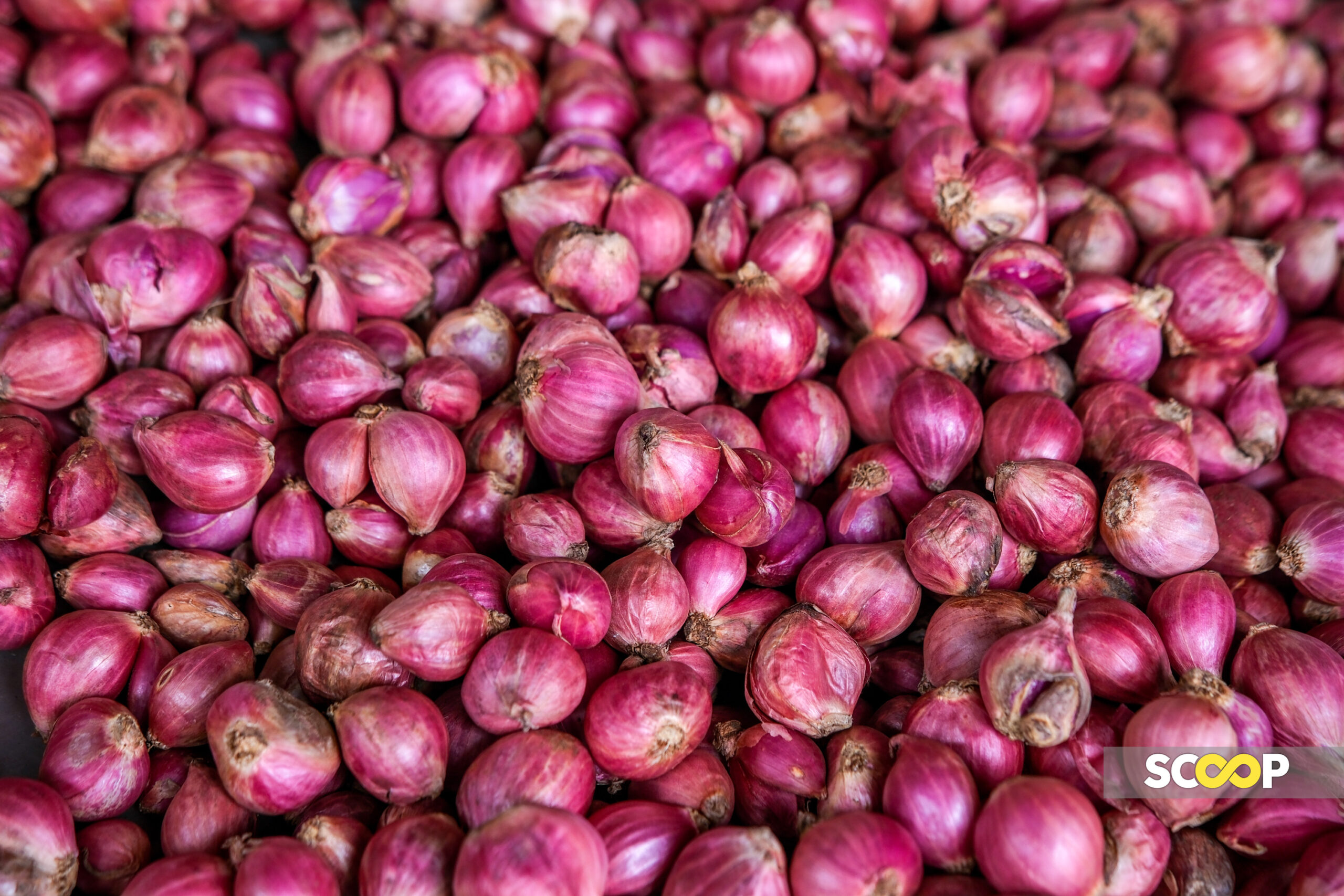
KUALA LUMPUR – Agriculture and Food Security Minister Datuk Seri Mohamad Sabu stated that 30% of the country’s demand for shallots will be fulfilled through local cultivation.
The commercial phase’s implementation period will extend over five years, from 2026 to 2030 and during this time frame, a cultivation area of 1,347ha specifically allocated for onions is set to be developed.
“With this, we anticipate a production yield of 14,470 tonnes, which is expected to fulfil 30% of the local demand by the year 2030,” he said to a question posed during Minister’s Question Time this morning.
Mohamad also said that the National Farmers Organisation, or Nafas, has already initiated shallot cultivation in several areas in Perlis and Selangor, covering 1.2ha, as well as in Bikam Farm, Perak, where an additional one-hectare cultivation area has been established.
He was responding to a question posed by Datuk Idris Ahmad (Bagan Serai-PN), who sought details on the ministry’s efforts to decrease dependency on imported onions.
The first harvest is anticipated in April 2024.
“The pre-commercial phase is aimed at assessing the potential of shallot cultivation in Malaysia from 2024 to 2025,” said Mohamad.
“The Malaysian Agricultural Research and Development Institute (Mardi) will supply a total of 70 tonnes of small onion seeds during this phase.
“Additionally, 230kg of shallot seeds will also be provided,” he added.
Mohamad said at the same time that a planting programme will also be initiated, with 100ha – 50ha in 2024 and another 50ha in 2025.
“The anticipated production yield is 5 tonnes a hectare, allowing for the possibility of planting onions twice a year. The expected onion production for this phase is 1,000 tonnes,” he added.
It was previously reported that Mardi had successfully produced three varieties of red onion, namely BAW-1, BAW-2, and BAW-3, last year.
Currently, Mohamad said Malaysia relies entirely on imported onions sourced from India, the Netherlands, China, Pakistan and Thailand.
The imported varieties include large onions, small onions and garlic.
“In 2022, Malaysia imported 687,000 tonnes of onions valued at RM1.58 billion. Of this total, 38 thousand tonnes of small onions, worth RM81.5 million, were imported to meet domestic consumption needs.
The ministry is concentrating its efforts solely on the development of small onions and shallots. This is because big onions and garlic cannot be cultivated in Malaysia due to the unsuitable climate conditions.
Last year, India imposed a ban on the import of onions following the rise in food prices and political upheavals, especially with the impending parliamentary election in India this year.
India is the largest onion exporter to Malaysia, with 36%, while China and Thailand contribute 20 and 7%, respectively. – February 28, 2024