

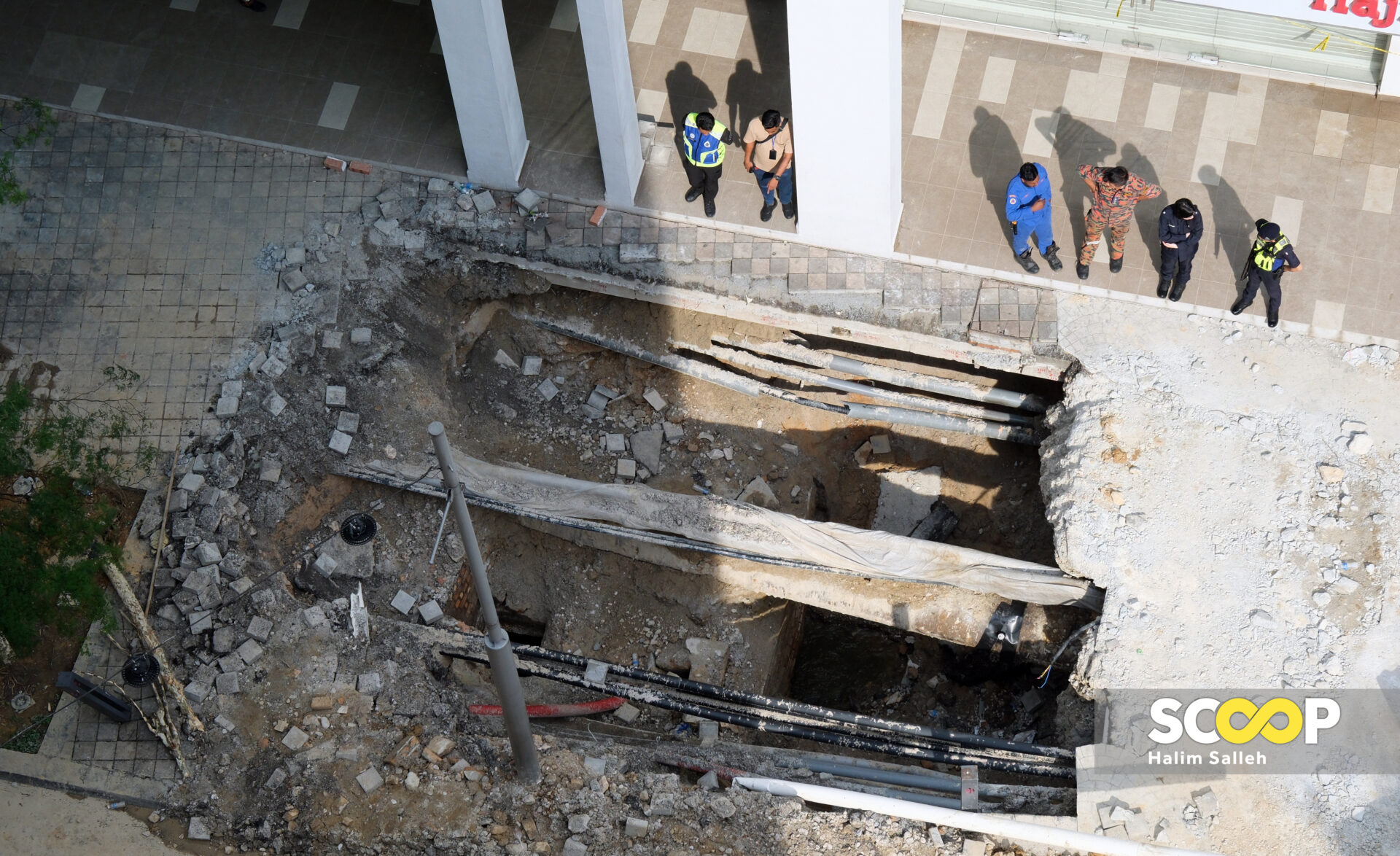

KUALA LUMPUR – A corroded sewer pipe structure, weakened by chemical reactions and unstable soil conditions, has been identified as the primary cause of the sinkhole incident at Jalan Masjid India last August.
Minister in the Prime Minister’s Department (Federal Territories) Datuk Seri Dr Zaliha Mustafa revealed that a special task force, led by Kuala Lumpur City Hall (DBKL), had investigated the incident. The task force’s findings debunked earlier public concerns that a limestone layer beneath the area had contributed to the sinkhole.
“The site of the incident lies on the Kenny Hills Formation, underlain by schist rock. The limestone layer is found at depths of 60 to 70 metres, meaning the incident cannot be attributed to limestone,” Dr Zaliha said during her response to Datuk Yusuf Abd Wahab (GPS-Tanjong Manis) in the Dewan Rakyat.
She further explained that the sewer pipe’s failure, caused by corrosion and soil instability, led to the formation of a cavity beneath the pedestrian walkway, ultimately resulting in the sinkhole.
The incident occurred on the morning of August 23 when Indian tourist G. Vijaya Lakshmi, 48, fell into an eight-metre-deep sinkhole that suddenly appeared at her feet.
Dr Zaliha confirmed that the full investigation report had been submitted to the Cabinet on August 20, with a special public report expected to be released by DBKL by the end of this year.
In addition, DBKL is conducting geotechnical studies on major roads within Kuala Lumpur’s Golden Triangle to assess soil stability. These studies, employing methods like borehole resistivity, Ground Penetrating Radar (GPR), Light Detection and Ranging (LiDAR), and Interferometric Synthetic Aperture Radar (InSAR), are aimed at identifying any potential risks for sinkholes.
“Preliminary findings suggest no areas have been flagged as high-risk for sinkhole formation. This study is crucial for safeguarding infrastructure, particularly ahead of the ASEAN Summit 2025,” she added.
Dr Zaliha also announced the establishment of a more efficient emergency response team (ERT) to ensure rapid and effective responses in the event of a similar incident in the future. – October 23, 2025